

Protecting Natural Ecosystem Processes in Florida’s Urban Stormwater Ponds
Florida is a state rife with nature, with three national parks, 1,350 miles of coastline, and thousands of lakes and rivers. Yet, among the natural beauty in mainland America’s southernmost state is rapid urban development and sprawl.
Almost 90% of the state’s population lives in urban areas, which are encroaching on natural land and often deteriorating the land they’ve already claimed. Still, natural environments persist in the concrete jungles, such as in urban stormwater ponds and streams.
Scientists in Florida are researching the interactions between urban development and the nature that still exists within cities.
This is the work of AJ Reisinger, an associate professor in the Department of Soil, Water and Ecosystem Sciences at the University of Florida. After spending much of his career studying human impact on rugged, remote rivers and streams from Alaska to Utah, Reisinger now studies water bodies that have been drastically altered by, or designed specifically for, urban centers.
Reisinger says that, with urban development across the state, a lot of natural ecosystem functions are being lost. When these functions, such as pollutant filtration or nutrient absorption, are lost or diminished, it can harm the natural environment
Therefore, Reisinger is turning to understanding and improving the natural systems that still exist in these urban centers. He and his colleagues are working to understand these drastically altered environments to protect both people and the planet.
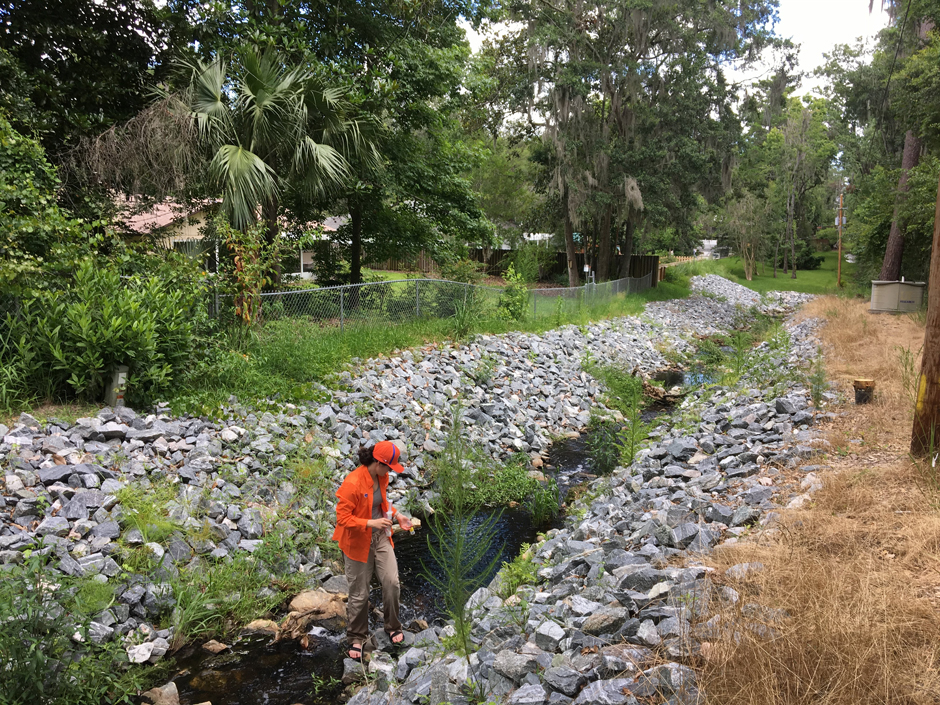
University of Florida summer undergraduate researcher Morgan Gallagher collects a water sample from a stream restoration project in Gainesville, FL as part of her Summer Undergraduate Research Fellowship in the Urban Ecosystem Ecology Lab. (Credit: AJ Reisinger)
Stormwater Ponds in Florida Urban Centers
Florida is the flattest state in the country, and receives over 50 inches of rain annually. Add tropical storms on top of its geography, and the “Sunshine State” shows why it’s extremely susceptible to flooding conditions.
In urban and suburban areas where impermeable surfaces lead to even more stormwater runoff, infrastructure is designed to mitigate the risk of flooding. In Florida, a common practice is building stormwater ponds, which collect rain runoff and the pollution it may carry.
Reisinger says that in Florida alone, over 75,000 of these ponds have been constructed, with more to come. Designed to protect natural environments and drinking water from harmful pollutants that may be carried in stormwater runoff, scientists are realizing they may not be as effective as once thought.
“There’s these expectations that these stormwater ponds are supposed to provide water quality benefits,” Reisinger says. “But what has been really shown when people go out and measure their functioning from a water quality perspective, the ponds aren’t as good as we think they should be.”
Specifically, Reisinger says that many stormwater ponds aren’t removing as much nitrogen as they need to. Ponds are designed to slow down water, settle out pollutants to the bottom of the pond, and allow for enhanced biological removal. However, many of the biological processes intended to remove pollutants don’t work as effectively as predicted, and Reisinger is working to figure out why.

Undergraduate student Connor Morang evaluates leaf litter decomposition bags deployed in an urban stream in Gainesville, FL, as part of his honors thesis in the Urban Ecosystem Ecology Lab at the University of Florida. (Credit: AJ Reisinger)
Working with a National Science Foundation grant, Reisinger is researching the natural processes that are driving, or rather, failing to drive, pollutant removal in these ponds. He was brought into this work by a stormwater engineer at the University of Florida in 2018. Reisinger’s natural science expertise was an important addition, because while some fail to see the nature in these ponds, it is vital for their design.
“[The engineer] introduced me to the systems, and I applied my natural ecosystem, biogeochemical, nutrient cycling mind to figure out why some things weren’t working as well as expected,” he says
Reisinger and his colleagues use HOBO Dissolved Oxygen Data Logger, Pendant Temperature/Light 64K Data Logger, and Water Level Data Logger to continuously monitor temperature, light, dissolved oxygen, and water levels in the stormwater ponds. He explains that these parameters allow them to estimate gross primary production and respiration, key to describing the biological activity of the entire ecosystem.
The natural processes that drive pollutant filtration in these ponds are not understood in full yet, but Resinger is working toward that goal. By understanding them, new ponds can be designed to better filter pollutants and protect surrounding environments and drinking water sources.

Members of the Urban Ecosystem Ecology Lab at the University of Florida deploying sensors and collecting samples from a residential stormwater pond in Gainesville, FL, as part of an NSF-funded research project focused on stormwater pond management and ecological functioning. (Credit: AJ Reisinger)
Natural Environments Existing with Development
When mitigation strategies such as stormwater ponds fail to perform their designed functions, pollutants can find their way to urban streams and the groundwater. Reisinger says this can create problems throughout a watershed, underscoring the importance of having efficient green infrastructure.
“How can we maybe maximize some of these processes, if things are failing or not working as efficiently as we think they should?” Reisinger questions, referencing the questions driving his research on stormwater ponds.
Many urban streams are succumbing to harmful urban pollution. Reisinger also works on urban streams, and his colleagues continue to monitor their natural processes to understand both how they function and where outside environmental pressures arise.
An urban stream’s natural functions could be leveraged to fill the gaps currently left by stormwater ponds. Reisinger says that understanding how Florida rivers specifically are filtering nutrients is important, given its unique tropical climate.
A YSI ProDSS is utilized to record various water quality parameters in the field, and a ProSolo allows researchers to measure dissolved oxygen levels, estimate stream primary production, and respiration.

Urban Ecosystem Ecology lab member Dr. Emily Taylor measures stream discharge using a SonTek FlowTracker underneath an overpass on Sweetwater Branch Creek in Gainesville, FL. (Credit: AJ Reisinger)
However, Resinger says many urban developers are still turning to constructing natural ecosystems to alleviate the pressures of urban development. Reisinger also works with developers who want to build “constructed wetlands” to improve water quality after effluent leaves the wastewater treatment plant.
Using his research on maximizing the efficiency of natural ecosystems in urban areas, Reisinger is called upon to help design these wetlands to be as environmentally friendly and efficient as possible.
He appreciates the effort to use natural solutions to mitigate environmental degradation, even if the natural systems are artificially created. Due to work like Reisinger’s, land developers and other stakeholder groups are realizing the benefit of using nature’s filtration systems to reduce the damage from urban development.
“I think there is a continued, ongoing push to figure out how to make sure we can continue to protect and improve our water quality,” Resinger said.

Members of the Urban Ecosystem Ecology Lab at the University of Florida collecting and processing water samples from Hogtown Creek in Gainesville, FL. (Credit: AJ Reisinger)
Working With Different Stakeholders to Protect the Environment
In a position where he interacts with many groups outside of his own field, Reisinger says he must be open to alternative perspectives on the environment. Rather than vilifying every new development plan or inefficient stormwater pond design, he instead works with these groups to improve the infrastructure and capitalize on natural functions.
“One of the realities of my job is that there are a lot of different people wearing a lot of different hats that are all coming to the table,” Reisinger says.
He continues, “And science and scientific results are just one piece of the puzzle.”
Public perception and buy-in are also important for Reisinger, especially considering their proximity to his work. In his stormwater pond research, he works alongside sociologists and economists to gauge what residents look for in pond design as well.
Yet, science can work hand-in-hand with urban development to protect as much of the environment as possible. By being intentional with designing stormwater management and natural water filtration systems, Reisinger hopes that environmental degradation can be kept to a minimum in Florida.
He believes that when people start seeing the nature that’s all around them, they will be more willing to design urban systems that incorporate these natural processes.
“A recognition that there’s nature and natural opportunities everywhere, and opportunities to improve our natural environment, no matter where we’re at or what we’re doing, is one thing that I hope for the future,” Reisinger says.

Members of the University of Florida Urban Ecosystem Ecology Lab gathering water quality data. (Credit: AJ Reisinger)



0 comments